
Carbon fiber idler roller for printing presses
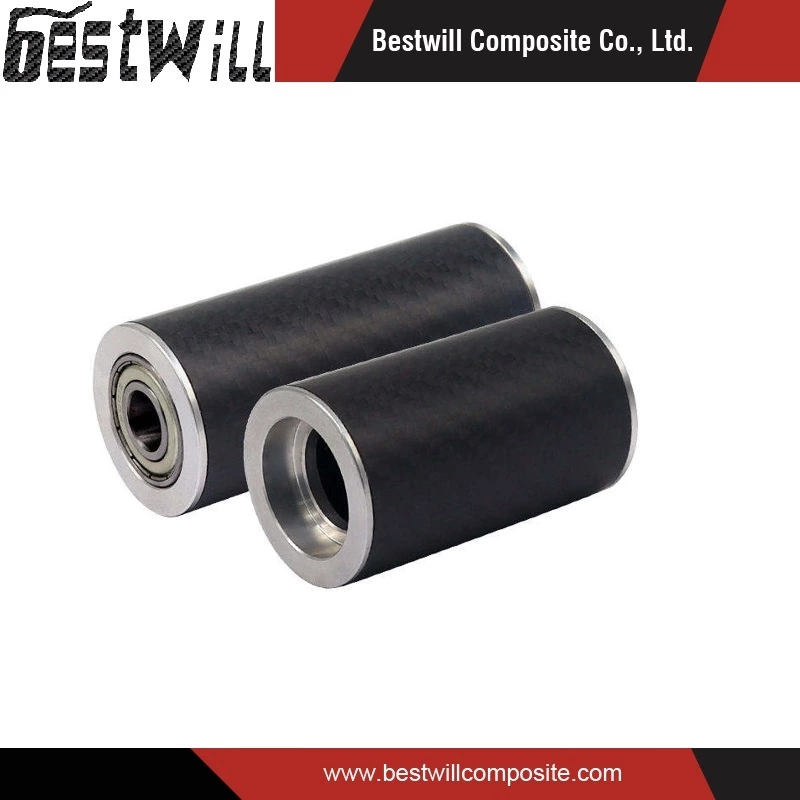
Carbon Fiber Roller
The carbon fiber roller is a lightweight and customizable product, featuring a 3k twill design with a choice of plain, glossy, or matte finish. It is manufactured with OEM technology for superior quality and performance.
Surface: twill plain glossy/matte/50%glossy matte
Operating temperature: below 200 degree
Strength: high pressure resistant/ high strength
Carbon Fiber Rollers for Web Processing: Construction, Surface Options, and Performance
Carbon fiber rollers are used to guide and support moving materials such as film, paper, foil, and textiles. Their lightweight structure and high stiffness can help improve roller responsiveness and material handling in demanding production environments.
A roller’s performance depends on more than its structural material. Dimensions, fiber arrangement, surface treatment, balancing, and end-fitting design all contribute to how it operates within a machine.
How Lightweight Construction Supports Web Handling
Reducing roller weight can lower rotational inertia, allowing the roller to respond more readily during acceleration and deceleration. This is particularly useful when processing delicate materials that require controlled web tension.
Carbon fiber also offers high stiffness relative to weight. A suitably designed roller can limit barrel deflection across its working width, helping maintain consistent support for the moving material.
These characteristics can be valuable in wider production lines, where maintaining stiffness with a conventional metal roller may require a heavier structure.
Composite Construction and Manufacturing
Carbon fiber rollers typically consist of a composite tube connected to shaft ends or journals. Filament winding is one manufacturing method used to produce the tube, placing resin-impregnated fibers around a rotating mandrel.
The winding pattern, fiber type, resin system, and wall thickness can be selected to meet specific structural requirements. This allows the roller body to be engineered for its intended span, load, and operating conditions.
The complete assembly must also account for connections between the composite tube and its end fittings. These interfaces transfer loads and help maintain alignment during operation.
Roller Dimensions and Custom Components
Carbon fiber rollers can be manufactured in a range of lengths and diameters. Available dimensions depend on the manufacturing equipment, structural design, and application requirements.
Longer working widths require careful consideration of bending stiffness, allowable deflection, and dynamic behavior. Roller dimensions should therefore be selected together with the expected loads and operating speed.
Custom shaft ends, collars, and bushings can be incorporated to suit existing equipment or new machine designs. Mounting dimensions, bearing interfaces, and component materials should be specified as part of the complete roller assembly.
Balancing and High-Speed Operation
Low mass and high stiffness can help a carbon fiber roller achieve suitable dynamic performance at elevated rotational speeds. Precision balancing helps reduce vibration caused by uneven mass distribution.
However, no roller should be assumed vibration-free under all operating conditions. Smooth running also depends on bearing condition, alignment, mounting rigidity, and the relationship between operating speed and structural resonances.
A roller intended for high-speed service should be designed and balanced for its specified operating range.
Surface Coatings for Different Applications
The outer surface determines how the roller interacts with the web. Coatings should be selected according to material sensitivity, traction requirements, wear conditions, and chemical exposure.
For delicate films or coated materials, a smooth, carefully finished surface can help minimize marking and abrasion. Surface cleanliness and freedom from defects are also important.
Wear-intensive applications may require harder or more abrasion-resistant coatings. The appropriate choice depends on contact pressure, contamination, and the characteristics of the processed material.
Where chemicals or cleaning agents are present, protective coatings must be compatible with the substances, concentrations, temperatures, and exposure times involved.
Antistatic Options and Dust Control
Static electricity can attract dust and interfere with the handling of films, foils, and other sensitive materials.
Antistatic or electrically dissipative surface treatments can help control charge when combined with an appropriate grounding arrangement. The electrical behavior of the complete roller assembly should be checked against the process requirements.
Carbon fiber construction alone does not guarantee an antistatic surface. Resin layers, coatings, and connections can affect the path through which charge dissipates.
Grooved and Patterned Roller Surfaces
Grooved or patterned surfaces can be used to adjust the interaction between the roller and the moving web. Depending on their geometry, they may help manage entrained air or provide suitable traction.
The pattern must match the web material, tension, and production speed. A surface that works well for one material may mark or distort another, so application testing is useful before full production.
Effects on Bearings, Maintenance, and Productivity
A lighter roller may reduce the load associated with the roller’s own weight. Where this represents a meaningful share of the total bearing load, it can contribute to improved bearing operating conditions.
Bearing life also depends on web tension, lubrication, alignment, contamination, and speed. Lower roller weight does not automatically result in longer bearing life.
Potential operating benefits include more responsive handling, reduced maintenance interruptions, and higher usable production speeds. These benefits should be assessed against purchase cost, coating life, inspection requirements, and the actual limits of the production line.
Specifying a Carbon Fiber Roller
An effective specification starts with the working width, diameter, supported span, operating speed, process loads, and allowable deflection.
It should also identify the web material, surface finish, temperature range, chemical exposure, electrical requirements, and mounting details. These inputs allow the composite structure, surface treatment, balancing requirements, and end components to be designed together.
A properly specified carbon fiber roller can support stable web handling and reliable production. Its value depends on matching the complete assembly to the demands of the process.
Carbon Fiber Products: Customization, Materials, and Ordering FAQs
1. Can Carbon Fiber Products Be Customized for My Project?
Yes. Carbon fiber products can be manufactured according to your drawings, dimensions, and performance requirements.
To begin a custom project, provide available CAD files or technical drawings, along with the intended application, expected loads, operating environment, quantity, and surface finish. These details help the engineering team evaluate material selection, construction, and manufacturing options.
If the design is still being developed, technical support can help clarify requirements and identify practical production approaches.
2. What Are the Main Benefits of Carbon Fiber?
Carbon fiber composites offer high strength and stiffness relative to their weight. They can replace metal or plastic components in applications where weight reduction, structural performance, or resistance to rust is important.
Their properties can be tailored through fiber selection, orientation, and laminate design. Suitability for chemicals, elevated temperatures, or other demanding conditions depends on the resin system and the complete component design.
3. How Do I Choose the Right Carbon Fiber Grade?
The appropriate grade depends on the required stiffness, strength, weight, and budget.
Standard-modulus carbon fiber is widely used and often provides a practical balance of performance and cost. Intermediate-modulus grades can offer higher stiffness than standard-modulus fibers, with some grades also providing very high tensile strength. High-modulus fibers are selected primarily for applications requiring greater stiffness.
A higher modulus does not automatically mean higher strength or better overall performance. The finished component also depends on fiber orientation, resin properties, wall thickness, and manufacturing quality.
4. How Do Unidirectional and Woven Carbon Fiber Tubes Differ?
Unidirectional layers contain fibers aligned mainly in one direction, providing efficient reinforcement along that direction. Woven layers interlace fibers in two directions, commonly in plain or twill patterns.
Carbon fiber tubes often combine layers at different angles to meet bending, torsional, and other structural requirements. A woven outer layer can provide the familiar carbon fiber appearance and may also contribute to reinforcement and surface durability.
The visible weave does not reveal the complete internal structure. Tube performance should be assessed using the laminate design and relevant specifications.
5. What Finishing and Assembly Services Are Available?
Additional services can include sanding, CNC machining, spray finishing, bonding, and assembly.
Depending on the design, these processes can provide dimensional finishing, mounting holes, protective coatings, or connections to other components. Requirements should be confirmed during the quotation stage so that machining allowances, tolerances, and bonding surfaces can be considered before production.
6. Are You a Manufacturer or a Trading Company?
We are a manufacturer with our own production facility in China.
Custom manufacturing requirements, finishing options, and assembly needs can be discussed directly with our team during the project review.
7. Which Shipping Methods Are Available?
Shipping options include express delivery, air freight, and sea freight.
Express delivery is commonly used for samples, small shipments, and urgent orders. Air freight can suit shipments that require faster delivery, while sea freight is often more economical for large or heavy orders.
The most suitable method depends on the shipment’s dimensions, actual and volumetric weight, destination, delivery deadline, and budget. Shipping options and costs can be confirmed when the order details are available.